


SPS
Facade Mat Blanc
Matt acrylic paint for exterior facades and interior walls, including damp rooms. Resistant to weather and rubbing for a durable, high-coverage finish.
19,21 €
24-48hWater-based satin PU acrylic lacquer, tintable, for woodwork and interior surfaces. Scratch-resistant and washable, it dries quickly and remains practically odourless.
Estimated delivery: 24-48h
SPS SATIN PU-A is a water-based satin PU acrylic lacquer designed for finishing interior woodwork, as well as pretreated plastic or metal substrates. It spreads easily, resists scratches and skin grease, and keeps its colours and sheen over time. Supplied for tinting, it adapts to the colour of your project.
Surface preparation determines the result. On bare wood, first carry out any necessary repairs, then apply a coat of primer. Once dry, sand and remove the dust. Use SPS Universal Primer on bare wood and SPS ISO Primer on bleeding wood. Then sand lightly, remove the dust, and apply the lacquer.
On intact old paint, clean it with SPS Paint Cleaner and sand the surface thoroughly. Then apply a coat of SPS Universal Primer, leave to dry, sand lightly and remove the dust before the finishing coat.
For drying times between coats, the number of coats and coverage, please refer to the product's SPS technical data sheet.
| Usage | Intérieur |
| Nature | Laque acrylique PU à base aqueuse |
| Teinte | À teinter |
| Support | Bois, plastique et métal prétraités |
| Finition | Satinée |
| Séchage | Rapide, pratiquement inodore |
| Résistances | Rayures, graisses cutanées, lavable |
| Conditionnements | 750 ml, 1 L, 2,5 L |
The classic pitfall on woodwork is bleeding wood (tannins, knots). If you treat it with a standard primer, the marks will reappear under a satin lacquer, which highlights them. Plan on using SPS ISO Primer on these areas; it's what saves you from having to redo everything.
With a tintable product, estimate the total quantity before ordering. Have the entire required volume tinted in one go, or mix the tins together before starting, to avoid slight colour differences between two batches. Sand lightly and remove dust carefully before the finishing coat, as satin finishes do not forgive grit.
Non, elle s'utilise comme couche de finition sur support prétraité. Sur bois dénudé, appliquez d'abord le Primer universel SPS, ou le Primer ISO SPS si le bois est saignant. Poncez légèrement et dépoussiérez avant de peindre.
Non, la SATIN PU-A est prévue pour l'intérieur. Pour des boiseries extérieures, il faut choisir une laque adaptée à cet usage.
Si l'ancienne peinture est intacte, nettoyez-la avec le Nettoyant peinture SPS, puis poncez soigneusement. Appliquez une couche de Primer universel SPS, laissez sécher, poncez légèrement et dépoussiérez avant de passer la laque.
Oui, à condition que le support soit prétraité. La fiche technique la présente comme couche de finition sur bois, plastique ou métal prétraités.
La SATIN PU-A existe en 750 ml, 1 L et 2,5 L, à teinter. Pour une pièce entière de boiseries, calculez le volume total avant la teinte afin d'avoir une couleur homogène.
Matt acrylic paint for exterior facades and interior walls, including damp rooms. Resistant to weather and rubbing for a durable, high-coverage finish.
Colorless and extra matte water-based protective varnish for interior walls. Facilitates cleaning, protects dark shades from white marks and intensifies colors.
Extra-matt tintable wall paint for interior walls and ceilings. It applies easily without leaving marks, for a uniform finish.
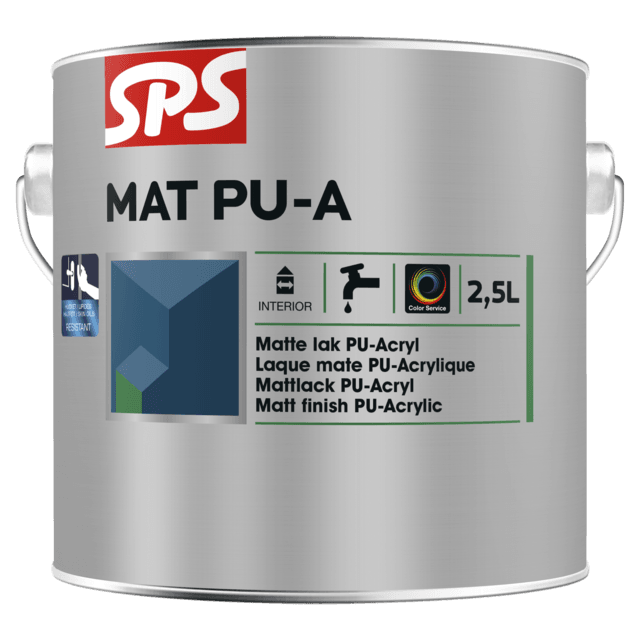
Water-based matt PU acrylic lacquer, tintable, for interior woodwork and furniture. Scratch-resistant and washable, it dries quickly and remains virtually odourless.